Reflections on Platforms, Partnerships, and the Year Ahead
The beginning of a new year in hospitality always brings a familiar mix of optimism and pressure. We talk about trends, we debate priorities, and we promise ourselves that this will be the year when technology finally simplifies rather than complicates our work. As 2026 begins, that conversation feels different, more grounded, and far more urgent.
In the first Shiji Insights Podcast episode of the year, I had the pleasure of speaking with Javier Campo from Amadeus. What struck me most was not a single prediction or soundbite, but a shared understanding that the industry is ready to move past fragmented thinking. We are entering a phase where integrated hospitality technology platforms are no longer aspirational concepts but practical necessities.Takeaways
Strategic partnerships succeed when roles and strengths are clearly defined.
True platforms eliminate fragmentation instead of managing around it.
Guest-centric design must be structural, not cosmetic.
Direct booking grows from relevance and clarity, not discounts.
Technology should empower people, not compete with them.
For many years, partnerships in hospitality technology were largely tactical. Integrations were built to satisfy immediate client requests, often without a broader architectural vision. That approach was understandable, especially in an industry under constant operational pressure, but it also created long-term complexity.
The strategic partnership between Shiji and Amadeus feels different because it was forged under very real constraints. The collaboration began during the pandemic, a time when theory gave way to survival and reliability mattered more than roadmaps. Clients were not asking for innovation theater; they were asking for systems that worked, consistently and at scale.
We are very clear that we can’t do everything. We want to be the best at what we do, and that means collaborating with the best partners rather than trying to build everything ourselves. Javier Campo
Hospitality technology has spent years celebrating connectivity. If systems could exchange data, the industry considered the problem solved. In reality, hoteliers were left navigating a web of interfaces, reconciliations, and manual processes that consumed time and energy.
What became clear in our discussion is that integration alone is no longer enough. The industry needs coherence, not just connection. A PMS and a CRS that merely “talk” to each other still place the burden of interpretation on hotel teams. A platform mindset removes that burden by design.
The ambition behind the Shiji–Amadeus alliance is to allow Daylight PMS and the Amadeus CRS to be operated as a single system. As Javier explained, We want hoteliers to stop seeing technological fragmentation and instead experience truly integrated platforms that work together as a single environment.
That statement captures the shift the industry is now ready to make.
This is what integrated hospitality technology platforms should deliver in practice, not as a promise but as a lived operational reality.
We want hoteliers to stop seeing technological fragmentation and instead experience truly integrated platforms that work together as a single environment.Javier Campo
Reflections on Platforms, Partnerships, and the Year Ahead
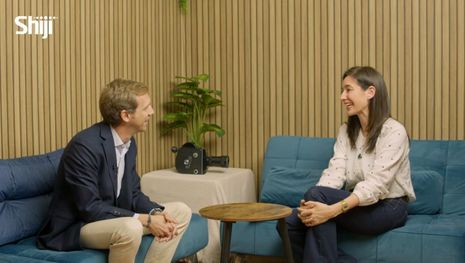
Florencia Cueto in conversation with Javier Campo from Amadeus. |
Platform thinking has existed in other industries for years, yet hospitality has been slower to adopt it. Historically, hotels accepted fragmentation as inevitable, building operational resilience through human effort rather than system design. Teams became experts at compensating for technology rather than being supported by it.
That model is no longer sustainable. Guest expectations are rising, distribution is becoming more complex, and staffing challenges demand efficiency without sacrificing quality. Platform thinking offers a way forward by aligning data, workflows, and teams around a single operational logic.
This is where the real transformation lies. Technology stops being a collection of tools and becomes an enabler of focus. When systems are designed to work together intuitively, hoteliers can shift their attention from managing complexity to shaping experiences.
Guest-centricity has long been a hospitality mantra, yet many systems were never designed with the guest at their core. Instead, they prioritized transactions, inventory units, and internal processes. The result was data abundance without clarity.
One of the most compelling aspects of Daylight PMS is that the guest profile is not an afterthought. It is the foundation. Every interaction, preference, and stay enriches that profile over time, creating a living record rather than a static file.
When this guest-centric PMS connects seamlessly with a CRS that manages inventory and distribution with the same level of integrity, the impact is significant. Data fragmentation begins to dissolve, and insight becomes actionable across departments. Revenue, marketing, and operations can finally rely on a shared source of truth.
This structural approach is what turns personalization from a promise into a capability.
Artificial intelligence dominated industry discussions throughout 2025, and with it came a sense of fatigue. Not because AI lacks value, but because the conversation often felt disconnected from operational reality.
What resonated in my discussion with Javier was a more measured perspective. Personalization does not need grand labels. It needs accuracy, relevance, and respect for the guest as an individual. Other industries have already proven that consumers are willing to share data when the value exchange is clear. Hospitality is now technologically ready to meet that expectation.
In 2026, personalization will no longer be framed as an emerging trend. It will be judged as a standard capability, delivered quietly through platforms that are designed to support it from the ground up.
Direct booking has been a strategic goal for years, yet too often it has been approached as a pricing battle rather than a value conversation. Discounts may drive short-term results, but they rarely build lasting loyalty.
What truly drives direct booking is clarity. When guests understand what makes a hotel unique and can easily assemble an experience that matches their intent, booking direct becomes the logical choice. The CRS plays a pivotal role here through digital merchandising and attribute-based selling.
By breaking down rooms, experiences, and services into meaningful attributes, hotels can present their full value proposition rather than a single rate. This approach shifts the conversation from price to relevance and reinforces brand identity over time. It is one of the most tangible benefits of integrated hospitality technology platforms done well.
One of the most honest reflections in our conversation was the recognition that clarity must come before expansion. Hoteliers have seen countless “next-generation platforms,” and skepticism is understandable.
The challenge for 2026 is not just technological delivery, but communication. Hotels need to understand what this platform is, what it replaces, and how it changes daily work. This is where industry moments like FITUR become essential, creating space for dialogue rather than one-way messaging.
Only when understanding is established can adoption follow with confidence.
As the conversation drew to a close, one idea remained central. Technology should feel almost invisible when it works well, yet it should never erase the human element that defines hospitality. Automation exists to remove repetitive tasks, not judgment, empathy, or creativity.
Platforms should give hoteliers the freedom to focus on leadership, culture, and guest connection. Partnerships make this possible because no single company can solve the complexity of hospitality alone. Collaboration is not a compromise; it is the foundation of sustainable innovation.
After talking with Javier, I felt optimistic about where hospitality technology is heading. The industry is moving toward a more intentional, coherent, and human-centered approach. The Shiji–Amadeus partnership reflects that evolution, grounded in realism and shaped by genuine operational understanding.
As 2026 unfolds, expectations will continue to rise. Guests will demand relevance and consistency, and hoteliers will expect technology to support rather than distract. Platforms will determine who can meet those expectations gracefully.
Organization
Shiji Group
www.shijigroup.com/
Saarbrücker Str. 36A
Berlin, 10405
Germany


Recent News
 Shiji Hits Major Milestone with 400th Hyatt Infrasys POS and Full Digital F&B Ecosystem Install Shiji Hits Major Milestone with 400th Hyatt Infrasys POS and Full Digital F&B Ecosystem Install |
 2025 Guest Experience: How Hotels Are Winning Satisfaction in a Year of Record Demand | By Bruno Saragat 2025 Guest Experience: How Hotels Are Winning Satisfaction in a Year of Record Demand | By Bruno Saragat |
|
More time for guests: the impact of seamless technology at Sunborn London |