Hotel dynamic pricing: Definition, examples, and strategies to use
What is hotel dynamic pricing?
Dynamic pricing is a pricing strategy for hotels that involves changing room rates daily, or even within the day based on real-time market conditions.
Taking supply and demand into account, dynamic pricing allows for prices to fluctuate regularly so the hotel can maximise revenue. This pricing option is well suited in today’s market and is one many hoteliers opt to use.
For example, in the morning you may have lower rates because your occupancy is low and demand is not strong. However, by evening your supply may have reduced and demand could be growing. Naturally, you want to increase rates at this point.
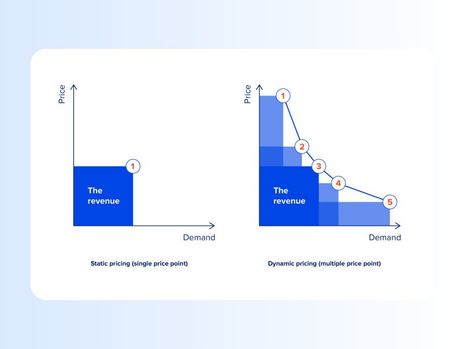
The difference between static and dynamic rates for hotels is that one is relatively rigid and the other is based on real-time market data.
Static rates are a traditional way of pricing hotel rooms which usually includes a standard weekday rate, elevated weekend rate, and increases during peak seasons. A static rate would be unaffected by external factors such as fluctuations in traveller demand or changes in competitor behaviour.
Dynamic rates, on the other hand, take all that information into account to give hoteliers the information they need to maximise revenue at all times. A dynamic rate is one that could change by the day, or even the hour, depending on current market conditions.
Dynamic pricing can be an important strategy for a hotel that’s looking to optimise occupancy and maximise profit.
By tracking market conditions in real-time, hotels can both prevent too many rooms staying unoccupied and rooms being sold for less than their maximum potential value.
Here are some of the advantages of using dynamic pricing at your hotel:
Hotel dynamic pricing: Definition, examples, and strategies to use
|
Dynamic pricing in the hotel industry works by adjusting room rates based directly on real-time market conditions such as special events, competitor behaviour, weather, customer behaviour, and general supply and demand.
The hotel revenue manager will track what’s happening in the market throughout the day and week to pick up on any noticeable changes. This will allow them to capitalise on opportunities to boost occupancy and/or maximise revenue.
A good dynamic pricing example for a hotel is when something out of the ordinary happens that enables hoteliers to respond and adjust their rates.
For instance, let’s say your hotel’s standard room rate is $210 per night when not in peak season. On weekends, it’s $220 and in peak season it’s $250.
Then, Taylor Swift announces a tour and your city is on the list of destinations she’ll be playing in. The dates for her shows fall on what would normally be a ‘standard’ Friday and Saturday night.
Tickets go on sale and excited fans snap up their tickets, with their attention quickly turning to accommodation for a night or even the whole weekend.
If you kept your rates static, your hotel would likely be the best deal around and you’d sell out your entire inventory for that weekend – potentially missing out on a lot of revenue.
However, if you react to the breaking news of the tour announcement by increasing your rates and even creating new packages, you’ll earn more from every booking than you normally would have.
Then, when supply dips lower as the date draws nearer and more hotels are selling out, you can raise your rates again because demand is still high for those who are booking with a smaller lead time.
Depending on your strategy, you might also try to entice some guests to increase their length of stay to take in more nights than just the dates of the show.
For instance, you could lower your rates back down for Sunday or Monday when most people might be flying out and airports would be busy and expensive. This could help maintain some of your occupancy and keep the revenue flowing in for a little longer.
This is an example of how dynamic pricing can work for a hotel.
A hotel dynamic pricing algorithm can be used to focus on particular areas of the market and what responses should be made.
It’s a set of rules to follow to achieve a set desired outcome. For example, an algorithm might be created to watch competitor occupancy and room rates to price match, undersell to win occupancy, or oversell to maximise revenue when they are sold out.
Often, algorithms are run by machines and there are dynamic pricing systems available to hotels. But algorithms can also be done manually. For instance, a recipe is also an algorithm.
Most hotels will have some kind of software to help them track real-time market conditions, before they decide how and when to adjust rates. Others ways use a completely automated approach, whereby the system will adjust the rates for them based on preset parameters and rules.
There are a few ways to put dynamic pricing into action and also some different ways to analyse performance and make adjustments.
Here the five best ways to apply dynamic pricing at your hotel:
Keeping an eye on your own occupancy and comparing it alongside your competitors is a great way to price your hotel to advantage. If you notice your closest competitor sell out, it means you then have a monopoly on supply. This allows you to sell your remaining inventory at a higher rate.
Similarly if your occupancy is low and you could lower your rate to ensure it is less than what your competitor is charging. This will help your hotel drive more demand than other properties in the area.
On some days, there might be a high number of flight cancellations due to weather or other factors. It pays to take notice of what’s happening around you in real-time so you can quickly capitalise on opportunities to capture extra bookings or maximise profit.
Events like the Taylor Swift example allow you to forecast stronger periods of performance and plan ahead throughout the year, instead of relying solely on your traditional peak season to cash in.
If you notice particular booking patterns such as more last-minute reservations at a certain time of year, or a particular audience segment opting for packages, you can start to forecast more accurately and strategise for greater success.
In summer, people might be more concerned about getting a room with a view than they are in winter, for instance. Or, you might notice the rooms close to the bar and restaurant are much more popular on weekends, while rooms closer to the gym or work spaces are more popular during weekdays.
Hotel groups and chains often struggle with efficiency – with multiple properties and a lot of rooms and room types to sell, getting new offers created and out to market quickly is important.
But it’s hard to take a dynamic approach to this, because by the time everything has been done the market has changed again.
Here’s a few best practices that will help:
SiteMinder Limited (ASX:SDR) is the name behind SiteMinder, the world's leading hotel distribution and revenue platform, and Little Hotelier, an all-in-one hotel management software that makes the lives of small accommodation providers easier. The global company is headquartered in Sydney with offices in Bangalore, Bangkok, Barcelona, Berlin, Dallas, Galway, London, Manila and Mexico City. Through its technology and the largest partner ecosystem in the global hotel industry, SiteMinder generates more than 125 million reservations worth over US$50 billion in revenue for its hotel customers each year. For more information, visit siteminder.com.
Contact
Dean Elphick
Senior Content Marketing Specialist
Email: dean.elphick@siteminder.com
Organization
SiteMinder
https://www.siteminder.com
Bond Store 3, 30 Windmill Street
Millers Point, NSW 2000
Australia
Email: media@siteminder.com


Recent News
 Hotel dynamic pricing: Definition, examples, and strategies to use Hotel dynamic pricing: Definition, examples, and strategies to use |
 Shoulder seasons challenge peak periods as year-round hotel demand strengthens in 2025: SiteMinder Shoulder seasons challenge peak periods as year-round hotel demand strengthens in 2025: SiteMinder |
|
SiteMinder launches 20th anniversary year with major sweep at 2026 HotelTechAwards |