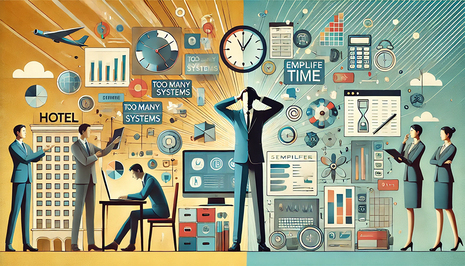
Too Many Systems, Too Little Time: How Hotels Can Simplify Tech and Empower Teams (source: HN created with DALL·E)
A guest walks up to the front desk. The receptionist glances at the screen and already knows the guest prefers feather pillows, skipped housekeeping during their last three stays, and charged over $600 in spa and F&B services the last time they were here. Housekeeping’s mobile device pings with an early arrival request. Meanwhile, the marketing team receives a real-time trigger to offer the guest a spa voucher tailored to their usual treatment. All of this happens without a single email, phone call, or Slack message.
This is the promise of a unified, decluttered hotel tech stack. Not just fewer systems, but smarter ones: connected tools that free up staff to serve, not search. Here’s how hotels can simplify, integrate, and actually empower their teams with technology that works together.1. Map the Current State
Before you declutter, you need to know what you’re dealing with. Most hotel groups are running a patchwork of legacy and cloud-based systems, often duplicated across departments and properties.
TIME Hotels, for example, operated 17 properties with multiple systems and varying workflows. A centralized audit revealed overlapping tools, inconsistent reporting, and bottlenecks due to manual processes. By switching to Daylight PMS, they reduced administrative workload by 30% and unified operations under one platform, paving the way for future growth and easier onboarding of new properties.
Conduct a full tech stack audit. Flag:
Shiny features don’t matter if systems can’t talk to each other. Every new tool must be evaluated for its ability to connect and share data with your core stack.
Ruby Hotels implemented Daylight PMS alongside Infrasys POS and Reviewpro Reputation. By focusing on systems that offered native API integrations and shared guest data, they personalized every stay without burdening staff with new logins or manual syncing.
Unified systems led to:
Choose platforms with open APIs and strong integration ecosystems, not just features in isolation.
Middleware can help multi-property groups modernize incrementally without a complete rip-and-replace.
At TIME Hotels, middleware played a key role in harmonizing data across properties in the Middle East, where regulatory compliance and tax handling vary by country. Integrating middleware with Daylight PMS enabled seamless interoperability and faster adaptation to local regulations,without compromising operational efficiency.
Look for middleware solutions that offer:
Tech should support people, not the other way around. Many hotels still design workflows around legacy tech limitations.
Langham Hotels adopted Daylight PMS as a statement of their commitment to exceptional service. With Single Guest Profiles and universal search, staff can view preferences, loyalty history, and requests across locations on a single interface.
By consolidating data and interfaces, Daylight PMS helps teams:
Simplification doesn’t mean replacing everything at once. Start with high-friction areas: check-in, housekeeping, upsells, and guest communication.
Dakota Hotels, for example, formed cross-functional teams to guide their implementation of Daylight PMS and Infrasys POS. By learning from each rollout and improving with each phase, they accelerated adoption and minimized disruption across properties.
Best practices:
Decluttering your tech stack isn’t just about reducing vendor count, it’s about creating space for staff to focus, connect, and delight guests.
With Daylight PMS, hotel groups like TIME, Langham, and Ruby have proven that a connected, streamlined system improves satisfaction on both sides of the front desk.
When systems talk, teams move faster. Guests feel seen. And operations finally make sense.
Technology should be the quiet enabler in the background, not a daily struggle. Simplify, integrate, and unlock more with less.
 From Patchwork to Platform: The Case for Unified Hotel Systems | By Michael Heinze From Patchwork to Platform: The Case for Unified Hotel Systems | By Michael HeinzeThursday 7 August 2025 |
 Getting Technical with What a Centralized Hotel Platform Can Enable | By Adam Mogelonsky Getting Technical with What a Centralized Hotel Platform Can Enable | By Adam MogelonskyTuesday 5 August 2025 |
 AI Alone Won’t Save You: Why Hospitality Tech Still Needs Structure | By Steven Hopkinson AI Alone Won’t Save You: Why Hospitality Tech Still Needs Structure | By Steven HopkinsonThursday 24 July 2025 |
 From Crown Jewels to Compliance: 5 Ways to Buid a Cyber‑Resilient Hotel Tech Stack | By Aleksander Ludynia From Crown Jewels to Compliance: 5 Ways to Buid a Cyber‑Resilient Hotel Tech Stack | By Aleksander LudyniaTuesday 15 July 2025 |
|
Connecting the Dots: Shiji’s Approach to Seamless Data | By Adam Mogelonsky Thursday 10 July 2025 |
|
Data Sovereignty Is the New Hospitality Imperative: Why Hotels Need to Rethink Their Tech Stack Now | By Aleksander Ludynia Tuesday 8 July 2025 |
 Seamless by Design: Why Unified Hotel Tech is No Longer Optional Seamless by Design: Why Unified Hotel Tech is No Longer OptionalThursday 3 July 2025 |
 From Guests to Data to Dollars: 5 Ways Unified Hotel Tech Boosts Revenue and Loyalty | By Wolfgang Emperger From Guests to Data to Dollars: 5 Ways Unified Hotel Tech Boosts Revenue and Loyalty | By Wolfgang EmpergerTuesday 1 July 2025 |
|
Forget Best-of-Breed: Why All-in-One Systems Are the Future of Hotel Technology | By Wolfgang Emperger Wednesday 25 June 2025 |
 Building Clean Data Foundations for AI in Hospitality | By Henri Roelings Building Clean Data Foundations for AI in Hospitality | By Henri RoelingsTuesday 9 September 2025 |
|
Hotel Cybersecurity in 2025 Emphasizes the Human Stack Monday 1 September 2025 |
|
Reframing Data Security and Sovereignty as a Hotel Team and Guest Benefit | By Adam Mogelonsky Monday 25 August 2025 |
Organization
Shiji Group
www.shijigroup.com/
Saarbrücker Str. 36A
Berlin, 10405
Germany


Recent News
 Emotional Luxury Hospitality: Jesús Terrés on Travel, Meaning, and the Power of Details Emotional Luxury Hospitality: Jesús Terrés on Travel, Meaning, and the Power of Details |
|
Shiji Hits Major Milestone with 400th Hyatt Infrasys POS and Full Digital F&B Ecosystem Install |
 2025 Guest Experience: How Hotels Are Winning Satisfaction in a Year of Record Demand | By Bruno Saragat 2025 Guest Experience: How Hotels Are Winning Satisfaction in a Year of Record Demand | By Bruno Saragat |