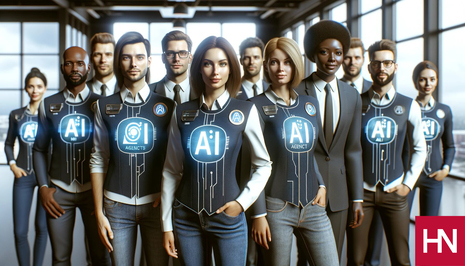
Generative AI Agents Promise to be a Boon for Hotel Operations
As of now, the common sentiment around Generative AI (genAI) and the use of large language models (LLMs) or generative pre-trained transformers (GPTs) for hospitality is centered around chatbots and their ability to answer guest inquiries and, in some cases, complete standard room reservations. While we all inherently grasp that there are applications far more advanced than these already-advanced functionalities, standing above the rest are the AI agents that can be trained to perform specific and rather complex tasks.
You might ponder why we don’t already have these available to us, but as Oracle has highlighted in their latest article on the subject, it is best to proceed cautiously, even as a series of powerful AI tools have already been deployed on the Oracle Cloud Infrastructure (OCI) for departments including HR, finance, sales, front desk, SCM and marketing. To answer why caution is advised regarding some potential risks in having bots run operations without human oversight, we can look at one example: a recent court case involving the Canadian travel industry where an AI hallucination caused a lot of headaches for Air Canada, the country’s leading airline. In this case, a passenger was told by the AI chatbot that they could apply for a reduced bereavement airfare retroactively within 90 days of the flight date. However, this contradicted the corporate policy as stated on the website, which did not allow refunds for travel that had already transpired. The AI had imagined or ‘hallucinated’ something that was inaccurate. During the subsequent trial, Air Canada was found responsible for the policy as stated by its AI chatbot under the guise of ‘negligent misrepresentation’. It had to honor the refund. To add my own notes on the case, this is hardly the first or the last time we will see a hallucination cause problems for a company. And the chances for the creation of an inaccurate pattern or model only grow as we start to expand the uses of AI into the territory of ‘agency’. For instance, genAI has been cited as a tremendous tool for automating tasks such as scheduling housekeepers or juggling room reservation assignments. But what if there’s a mistake and room attendants are told to start their shift at 3am or a group room block ends up scattered across an entire 500-key hotel? As a human, I’m already biased in what unfortunate scenarios I can imagine; it’s difficult to predict what an AI will hallucinate because they don’t think quite like we do. This all said, the benefits of AI agents are far too great to ignore and hotel tech leaders are devoting plenty of resources to QA to minimize the risks, which brings us to an important term for hoteliers to keep in mind regarding the deployment of AI agents: retrieval-augmented generation (RAG). While out-of-the-box LLMs and GPTs are trained on vast quantities of data, RAG aims to limit the range of responses from an LLM to only those available from your own enterprise data sources or ‘internal knowledge base’. Per its namesake, RAG works to ‘augment’ a human prompt or query into a foundation model by ‘retrieving’ then adding into that prompt the contextually relevant data in order to ‘generate’ a specific AI response or task to be performed. Whether this augmentation is ruled-based, semantic-based or dependent on AIs interacting with APIs, RAG holds the most promise in the near future to extend the capabilities of genAI immensely for hotels while limiting the risk of hallucinations or the improper handling of transactional data. By giving accurate context to prompts, AI agents can then be tasked and trusted with the use cases that have long been promised but seldom delivered. Some ideas for where AI agents can take us:
There’s obviously a ton more happening under the hood to make these technologies a reality; ask your vendors what their RAG roadmap is and how they are supporting this next-level automation.
 Data Maturation Represents the Essential Reason for Deploying Machine Learning Today | By Adam Mogelonsky Data Maturation Represents the Essential Reason for Deploying Machine Learning Today | By Adam MogelonskyMonday 11 March 2024 |
 Understanding GenAI with Its Applications that Hotels can Realize in 2024 | By Jason Bryant Understanding GenAI with Its Applications that Hotels can Realize in 2024 | By Jason BryantThursday 29 February 2024 |
|
Generative AI and Neural Net Fundamentals Tuesday 13 February 2024 |
|
Machine Learning Basics for Hotel and Correlation versus Causation Modeling Tuesday 6 February 2024 |
|
Introducing Machine Learning’s Applications for Hotel Operations | By Jason G. Bryant Tuesday 23 January 2024 |
|
The AI-Fueled Organization: Transforming for the Future with Oracle | By Jason G. Bryant Monday 15 July 2024 |
|
GenAI Copiloting Use Cases for Hoteliers Applicable Today | By Adam Mogelonsky Friday 14 June 2024 |
|
Three Real-World Examples of How AI Can Streamline Hospitality Workflows | By Jason G. Bryant Friday 7 June 2024 |
|
Machine Learning from PMS Data Extraction Enables Personalization and Segmentation | By Adam Mogelonsky Wednesday 1 May 2024 |
Organization
Oracle Hospitality
https://www.oracle.com/industries/hospitality/index.html
7031 Columbia Gateway Drive
USA
- Columbia, MD 21046-2289
Tollfree: (866) 287-4736
Email: oraclehosp_ww@oracle.com


Recent News
 Oracle Approved by IHG Hotels & Resorts as a Property Management Provider Oracle Approved by IHG Hotels & Resorts as a Property Management Provider |
|
PPHE Hotel Group Implements Oracle OPERA Cloud to Improve Operations and Drive Innovation |
|
Oracle Named a Leader in IDC MarketScape Worldwide Hospitality Property Management Systems 2025 Vendor Assessment |