
ML Explained (source: Created by HN with DALL·E)
There are many definitions of machine learning (ML). For purposes of this explainer, ML is the scientific study of algorithms and statistical models that computer systems automatically use in real-time to effectively perform a specific objective function (such as optimizing revenue) without using explicit instructions. Instead, ML relies on patterns and inference. All this is performed using a feedback loop so that each successive iteration further increases precision of the models, which drives and improves the objective function. This is made clear by considering the four primary components of a machine learning system:
ML allows the models to put out smarter information as it learns about consumer behaviors. It does so in a way that humans aren’t capable of by creating correlations based on massive amounts of data in real-time, at a speed humans can’t replicate.
 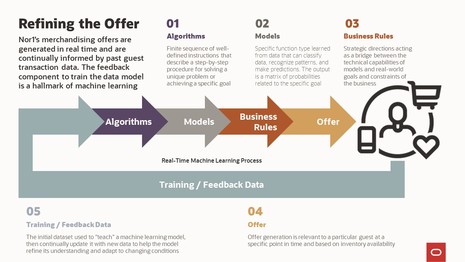
Lorem Ipsum
|
A significant misunderstanding for many is how ML is used to make decisions. Typically, humans make decisions based on “causation,” that is, X causes Y - If I change this variable, then this outcome will change.
ML systems on the other hand, make decisions based on “correlation,” where a very specific objective function has been defined (such as increased revenue) and each potential option (a presented upsell offer) is valued with a probability of a positive outcome. Over time and with each successive observation (transaction), the accuracy and number of probabilities increase.
Without the ability or resources to rapidly assess a large data source and to calculate thousands of permutations in real-time, “causation” is remarkably accurate. Causation, however, still has limitations; it can be difficult to replicate from one human to another, it’s usually not determined in real-time (a big handicap in today’s digital environment), and it works best with significant changes rather than smaller nuances. Many classic experiments have been debunked because they failed to see the big picture of correlation, that is, they fail to recognize that any number of factors can contribute to a conclusion. For instance, a study by the National Weight Control Registry found a connection between people who ate breakfast and successful weight loss. But this didn’t mean that eating breakfast caused weight loss. The study failed to control for other factors, such as whether these breakfast eaters worked out or what kind of diet they had. Scientists hadn’t established a causal relationship; they had only identified a correlating factor.
Hotels typically thrive on decision making based on the notion of causal relationships. If I decrease rates $10 per night during a slow period and bookings increase, then we tend to think that the rate decrease worked. But causal relationships are rarely so simple. Perhaps the rate decrease got the attention of an online channel, and the special rate was shared on social media. In this case, the increased exposure may have improved occupancy rates more than the actual rate change. Humans typically can’t recognize or calculate correlations clearly, but correlations are the foundation of ML. This is the real, undeniable usefulness of ML. When machines do this tactical work, then revenue managers, front desk staff, and others are freed up to do what they do best—strategize better ways to provide great service to the guest and drive revenue.
ML correlates vast amounts of data points to fine-tune recommendations. This can help save hotels from unnecessarily decreasing rates when what was really needed was a different approach—a better understanding of what guests were looking for, where the opportunities were, and what they would be willing to pay and when. Correlating hundreds of data points is something revenue managers and front desk agents cannot do, because humans are only able to make so many causal associations. But correlating positive and negative historical data (such as the rates that were booked and the rates that weren’t booked) can produce offers that drive revenue rather than undercut rates. Part of the problem with the historical data that most hotels use is that it only accounts for the rates that were paid; it doesn’t track the rates that weren’t booked, and this information (what wasn’t booked) is just as important as what was. When positive and negative data are fed into the models, machine learning can give hotels results based on probabilities. This tells the front desk agent which suite upgrade to offer and at what price, based on the probability that this specific guest is likely to book it.
Machine learning gives us decisioning capabilities we wouldn’t have otherwise. The ability to create probabilities and correlations vastly enhances not only the accuracy of decisions, but also the speed at which they are made. Real-time decisioning on the rates and offers that bring in guests— without the right offerings, what does a hotel achieve? — enables hotels to refocus their efforts on the hospitality at the industry’s core.
Related Links:
 The AI-Fueled Organization: Transforming for the Future with Oracle | By Jason G. Bryant The AI-Fueled Organization: Transforming for the Future with Oracle | By Jason G. BryantMonday 15 July 2024 |
 GenAI Copiloting Use Cases for Hoteliers Applicable Today | By Adam Mogelonsky GenAI Copiloting Use Cases for Hoteliers Applicable Today | By Adam MogelonskyFriday 14 June 2024 |
|
Three Real-World Examples of How AI Can Streamline Hospitality Workflows | By Jason G. Bryant Friday 7 June 2024 |
|
Machine Learning from PMS Data Extraction Enables Personalization and Segmentation | By Adam Mogelonsky Wednesday 1 May 2024 |
|
Generative AI Agents Promise to be a Boon for Hotel Operations | By Adam Mogelonsky Thursday 14 March 2024 |
|
Data Maturation Represents the Essential Reason for Deploying Machine Learning Today | By Adam Mogelonsky Monday 11 March 2024 |
|
Understanding GenAI with Its Applications that Hotels can Realize in 2024 | By Jason Bryant Thursday 29 February 2024 |
|
Generative AI and Neural Net Fundamentals Tuesday 13 February 2024 |
Organization
Oracle Hospitality
https://www.oracle.com/industries/hospitality/index.html
7031 Columbia Gateway Drive
USA
- Columbia, MD 21046-2289
Tollfree: (866) 287-4736
Email: oraclehosp_ww@oracle.com


Recent News
 Oracle Approved by IHG Hotels & Resorts as a Property Management Provider Oracle Approved by IHG Hotels & Resorts as a Property Management Provider |
|
PPHE Hotel Group Implements Oracle OPERA Cloud to Improve Operations and Drive Innovation |
|
Oracle Named a Leader in IDC MarketScape Worldwide Hospitality Property Management Systems 2025 Vendor Assessment |