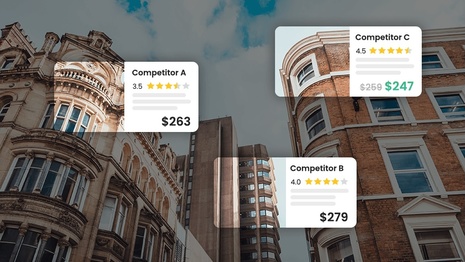
Why traditional compsets are holding your hotel back
“Who are my competitors?” It’s a question every hotel must answer. Yet, the way we define compsets (competitive sets) has evolved significantly. Defining a hotel’s competition used to be simple – look at the properties nearby with similar star ratings and price points. But in today’s market, that approach is no longer enough. Relying on outdated compset models can leave revenue opportunities on the table as traveler preferences, booking channels, and competitive landscapes shift faster than ever. With the rise of real-time data and AI-driven insights, hotels can refine their compsets, giving them a sharper competitive edge. In this article, we explore how hotel compsets have evolved and how revenue managers can adapt their strategies to stay ahead. A hotel’s competitive set is a group of hotels that compete with your property for the same guest. While traditionally defined by location, brand, and amenities, today’s compsets are increasingly segmented by booking behaviors and traveler demographics. Identifying comparable hotels helps you understand your competitive advantage. In particular, it allows you to: In the pre-internet era, compsets were primarily defined by two main factors: the same geographic area and the same star rating. Once they were identified, the focus was on pricing. Hoteliers would perform a daily call-around, phoning nearby hotels posing as potential guests to inquire about rates and availability so they could benchmark their own prices. The second era of compsets started when the internet brought online travel agencies (OTAs) and online bookings, making competition more dynamic. Between 1995 and 2018, the global hospitality industry more than tripled in size, growing from $522 billion to $1.86 trillion. Competition for hotels grew, and prices started to fluctuate more as revenue management systems made pricing strategies more sophisticated. Although hotels used a rate shopping tool to keep track of compset rates automatically across all sales channels, the basic elements of compsets didn’t change. However, as the market grew and evolved, this model started to show its limitations: Traditional comp sets were rarely updated and relied heavily on historical data, such as past pricing, occupancy rates, and guest reviews. This lack of flexibility failed to account for changes that would make old compsets less relevant, such as shifts in demand, new competitors entering the market, or historical competitors changing their strategies. Traditional approaches assumed guests only considered hotels in close proximity. However, as traveling became more accessible, the decision processes changed. Modern travelers are often flexible regarding destinations and may compare properties located in different neighborhoods, cities, or even continents. While the relationship between price and perceived value is still a deciding factor, what value means to travelers has changed. As McKinsey highlights, in the old days of traveling, destination came first. After that, the deciding factor was the level of accommodation, identified by star rating, while experiences—what to do once arrived and the overall vibe of the hotel—were an afterthought. However, in modern traveling, experiences have a much bigger influence on perceived value and willingness to pay. For example, luxury travelers are looking for exclusivity or personalized service, not just star rating. With today’s technology and access to data, hotels can redefine their compsets by integrating data from multiple sources. Property management systems (PMS) reveal booking patterns and occupancy trends, while customer relationship management (CRM) systems provide insights into guest demographics and preferences. Point of sale (POS) data highlights which amenities appeal to different market segments, and distribution data shows which competitors frequently appear alongside your hotels across OTAs and metasearch sites. Additionally, guest feedback and sentiment analysis can reveal shifting traveler priorities, such as increasing demand for pet-friendly stays or coworking spaces. AI and machine learning take this data a step further, enabling dynamic compsets that adjust in real time based on several key factors: By shifting from static to data-driven, adaptive compsets, hotels can make more informed pricing, marketing, and operational decisions. Let’s consider a 75-room boutique hotel located in downtown Los Angeles, known for its design-forward aesthetic, rooftop bar, and farm-to-table restaurant. Its target audience includes staycationers and international travelers. It’s priced higher than mid-range hotels but lower than luxury chains, making it attractive to affluent leisure travelers (couples, small groups, and solo travelers) seeking a premium experience. In its marketing messaging, the hotel highlights its proximity to cultural landmarks, nightlife, and business districts. Traditionally, this hotel’s compset includes nearby boutique properties, upscale chains, and independent hotels offering personalized service. However, an analysis uncovers deeper insights: Based on these findings, the hotel refines its compset beyond just nearby boutique hotels. The primary compset (direct competitors of the hotel, based on amenities, pricing, and guest experience) includes: The secondary compset (hotels that occasionally overlap with the boutique hotel’s target audience based on seasonal or niche preferences) includes: The tertiary compset (properties competing indirectly under specific circumstances) includes: To be more competitive with these compsets, the hotel plans the following marketing strategies: By rethinking compsets dynamically, hotels can proactively adjust pricing, marketing, and offerings, ensuring they remain competitive across multiple segments. Hotels can achieve this level of dynamic competitive set analysis with Cloudbeds PMS and its Intelligence functionalities. Cloudbeds collects billions of data points from bookings, guest interactions, and hundreds of partner integrations, then organizes and analyzes them using proprietary AI and machine learning algorithms. With Cloudbeds Intelligence, hotels can transform raw information into actionable insights to define their compsets, optimize rates, and align distribution channels effortlessly. Rates and promotions can be pushed across all channels in real time, ensuring competitive positioning. As the ecosystem grows, the application of AI and causal machine learning enhances both Cloudbeds and its partners, driving continuous innovation. The result is a powerful platform that simplifies competitive set analysis and empowers properties to stay ahead in the hotel industry.What is a hotel compset?
Why identifying your competitive set matters
Limitations of traditional compsets
Overreliance on historical data
Overemphasis on the geographic area
Outdated value metrics
A new era of compsets
Leveraging modern compsets: An example
Refining a hotel’s competitive set
Primary compset
Secondary compset
Tertiary compset
Influenced marketing strategies
Cloudbeds: Enabling modern compsets
Organization
Cloudbeds
https://www.cloudbeds.com/
3033 Fifth Ave Suite 100
USA
- San Diego, CA 92103
Phone: 6502450166
Email: info@cloudbeds.com


Recent News
 Historic Hotels of America® Chooses Cloudbeds as a Supplier Partner to Bring Seamless Operations to Landmark Hotels Historic Hotels of America® Chooses Cloudbeds as a Supplier Partner to Bring Seamless Operations to Landmark Hotels |
|
Cloudbeds unveils inaugural Cloudbeds Collection: 100 Properties redefining independent hospitality |
|
Cloudbeds and Ágora Partner to unify Hotel POS and Operations for Seamless Guest Experiences |