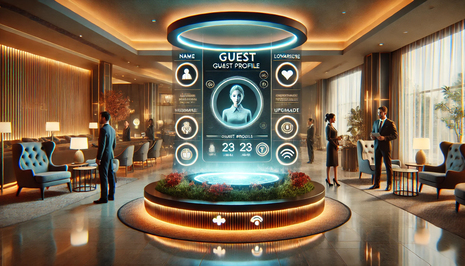
What experiences can you build with a centralized, real-time guest profile? (source: HN created with DALL·E)
As part of our Thematics campaign with Shiji Group on Single Provider for Seamless Data, this article looks at one of the most transformative ideas in hotel technology today: the centralized, real-time guest profile. Integrated systems hold the promise of unlocking new guest experiences and streamlining operations, but the real challenge lies in turning that promise into everyday reality. This theme came to the forefront during HITEC, in conversation with Ryan King. His guiding principle was clear: begin with the guest experience you want to deliver, then let technology serve that vision. As the industry moves towards a hub-and-spoke IT architecture, the potential of a unified, real-time guest profile becomes increasingly tangible. Powered by internal microservices, these profiles make guest information actionable at every touchpoint. What does this mean in practice? Several industry leaders have shared their perspectives on the experiences and operational changes that could emerge when this vision is fully realised.Bridging Operations and Technology
Matthew Clark, Regional Director of Sales for Asia Pacific and the Middle East at Shiji, has spent his career in both hospitality operations and technology. For him, the conversation with Ryan King encapsulates how these two worlds can successfully meet. When technology aligns seamlessly with operational needs, it becomes a natural extension of service delivery rather than a separate, siloed function.
Adam Mogelonsky, Partner at Hotel Mogel Consulting Ltd., points to a persistent gap between hotel and dining operations. He notes that guest preferences are rarely shared in real time across these silos. This creates missed opportunities for memorable interactions. With unified profiles, recognising a returning guest at the restaurant door and tailoring their dining experience instantly could become a standard rather than an exception.
For Mark Fancourt, Co-Founder at TRAVHOTECH, seamless data is about more than technology integration. He warns against limiting the discussion to the “single provider” label and urges hoteliers to focus on achieving consolidated business capability. This requires rethinking operational design, not just connecting systems. The reward, he argues, is the ability to elevate the very architecture of how a hotel operates.
Simone Puorto, Head of Emerging Trends and Strategic Innovation at Hospitality Net, sees this shift as a deeper transformation. Data, he argues, is no longer merely supporting the guest experience; it becomes the experience itself. In this computational vision of hospitality, data is the substrate, the interface, and the medium through which service is expressed.
Custódio Barreiros, Founder and CEO of EIP MGT, echoes Ryan King's emphasis that technology should serve the guest, not dictate the experience. His approach starts with defining the outcomes that make a guest journey memorable, and then selecting the technology stack to match. He foresees innovations such as channel-agnostic personalisation, frictionless self-service with human backup, and operational agility empowered by staff.
Not all experts fully agree with starting from the guest experience. Hospitality technology and revenue management consultant Ira Vouk argues that every initiative must be financially justified. Without a clear return on investment, no customer-facing enhancement is sustainable. For her, hospitality must balance its customer-centric ethos with the business realities of generating revenue.
Max Starkov, hospitality and travel technologist, believes the future lies in the hub-and-spoke model built on a cloud PMS with an open API. This acts as the hub, connecting to a range of third-party platforms via an integration marketplace. Such a structure allows guest, marketing, and operational data to flow effortlessly, enabling the flexibility and responsiveness that a modern hospitality business demands.
Although their priorities vary, all agree that a centralized, real-time guest profile can be a powerful tool for improving both service and operations. The next step is finding the most effective ways to put it to work.
 From Patchwork to Platform: The Case for Unified Hotel Systems | By Michael Heinze From Patchwork to Platform: The Case for Unified Hotel Systems | By Michael HeinzeThursday 7 August 2025 |
 Getting Technical with What a Centralized Hotel Platform Can Enable | By Adam Mogelonsky Getting Technical with What a Centralized Hotel Platform Can Enable | By Adam MogelonskyTuesday 5 August 2025 |
 AI Alone Won’t Save You: Why Hospitality Tech Still Needs Structure | By Steven Hopkinson AI Alone Won’t Save You: Why Hospitality Tech Still Needs Structure | By Steven HopkinsonThursday 24 July 2025 |
 From Crown Jewels to Compliance: 5 Ways to Buid a Cyber‑Resilient Hotel Tech Stack | By Aleksander Ludynia From Crown Jewels to Compliance: 5 Ways to Buid a Cyber‑Resilient Hotel Tech Stack | By Aleksander LudyniaTuesday 15 July 2025 |
|
Connecting the Dots: Shiji’s Approach to Seamless Data | By Adam Mogelonsky Thursday 10 July 2025 |
|
Data Sovereignty Is the New Hospitality Imperative: Why Hotels Need to Rethink Their Tech Stack Now | By Aleksander Ludynia Tuesday 8 July 2025 |
 Seamless by Design: Why Unified Hotel Tech is No Longer Optional Seamless by Design: Why Unified Hotel Tech is No Longer OptionalThursday 3 July 2025 |
 From Guests to Data to Dollars: 5 Ways Unified Hotel Tech Boosts Revenue and Loyalty | By Wolfgang Emperger From Guests to Data to Dollars: 5 Ways Unified Hotel Tech Boosts Revenue and Loyalty | By Wolfgang EmpergerTuesday 1 July 2025 |
|
Forget Best-of-Breed: Why All-in-One Systems Are the Future of Hotel Technology | By Wolfgang Emperger Wednesday 25 June 2025 |
 Building Clean Data Foundations for AI in Hospitality | By Henri Roelings Building Clean Data Foundations for AI in Hospitality | By Henri RoelingsTuesday 9 September 2025 |
|
Hotel Cybersecurity in 2025 Emphasizes the Human Stack Monday 1 September 2025 |
|
Reframing Data Security and Sovereignty as a Hotel Team and Guest Benefit | By Adam Mogelonsky Monday 25 August 2025 |
Organization
Hospitality Net
https://www.hospitalitynet.org
Boschcour 54
Maastricht, 6221 JR
Netherlands, The
Email: info@hospitalitynet.org


Recent News
|
Hospitality Net Announces Exclusive Global Syndication Partnership with "Not Done with Sloan Dean" Podcast |
|
Namron Hospitality: Comfort, Design, and the Human Kind of Personalisation |
|
2026 Starts Here: Events, Ideas, and the Conversations Shaping Hospitality | By Henri Roelings |